A loud sound was heard at around 1 am outside Kalia's residence near Shastri Market in Jalandhar, police said, adding that no one was hurt in the incident.
Javed Munshi, suspected to be a member of the outlawed 'Tehreek e Mujahideen' outfit in Kashmir Valley, was picked up from near Canning Hospital by a joint team of Jammu and Kashmir Police and West Bengal Police's Special Task Force, the officer said.
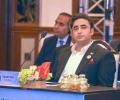
Bhutto, who served as the Foreign Minister earlier, addressed a briefing at the UN Headquarters in New York and sought reconciliation with India, making a plea for talks and Intel sharing between the two neighbours.
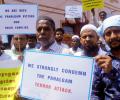
Pakistan Prime Minister Shehbaz Sharif has called on "brotherly" countries, including Saudi Arabia, to urge India to de-escalate tensions after the Pahalgam terror attack that killed 26 people. Sharif met with ambassadors from Saudi Arabia, the UAE, and Kuwait, reiterating Pakistan's commitment to peace in South Asia. He rejected India's accusations linking Pakistan to the attack, emphasizing Pakistan's own history as a victim of terrorism. The meeting comes amidst heightened tensions between the two countries.
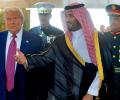
Acutely conscious that he's left with less than four years to create his legacy, Trump is undoubtedly a man in a hurry, observes Ambassador M K Bhadrakumar.

Announcing the launch of "Mission Sudarshan Chakra", Modi said it will be aimed at neutralising enemy threat and enhancing India's offensive capabilities.
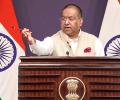
External affairs ministry spokesperson Randhir Jaiswal said India will keep the IWT in abeyance until Pakistan "credibly and irrevocably" abjures its support for cross-border terrorism.
The ministry of external affairs said the official has been given 24 hours to leave the country.

New York amps up security after concerns reported
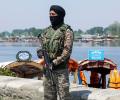
The United Nations Secretary-General, Antonio Guterres, has called for de-escalation between India and Pakistan, expressing deep concern over rising tensions following a terrorist attack in Jammu and Kashmir. Guterres reiterated his condemnation of the attack and urged both sides to avoid a confrontation, which he described as catastrophic. The Secretary-General has also offered his good offices to support de-escalation efforts. The President of the UN General Assembly, Philemon Yang, has also expressed concern over the escalating violence and called for a resolution through diplomatic means. Meanwhile, Pakistan has denied any involvement in the attack and reiterated its commitment to fighting terrorism.

Security agencies in Jammu and Kashmir are facing a new threat from 'bedroom jihadis' who use social media to spread misinformation and incite communal discord. These individuals, operating from their homes, are part of a sophisticated cross-border effort to destabilize the region by disseminating inflammatory content and propaganda.
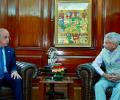
India briefed envoys of around 45 nations on the Pahalgam terror attack and its link to cross-border terrorism. The envoys were briefed in two batches by senior officials of the Ministry of External Affairs (MEA). India also announced punitive measures against Pakistan, including expulsion of Pakistani military attaches, suspension of the Indus Water Treaty of 1960 and immediate shutting down of the Attari land-transit post. Pakistan responded by shutting its airspace to all Indian airlines and suspending trade with New Delhi.
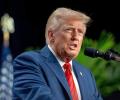
Trump said that leaders in India and Pakistan are "great leaders" and "they understood, and they agreed, and that all stopped".

Asserting that India will not tolerate any 'nuclear blackmail', Prime Minister Narendra Modi on Monday said operations against Pakistan have only been kept in abeyance and the future will depend on their behaviour.
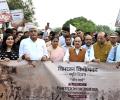
Instead, they argue, three actors shaped the division, "Jinnah, who demanded it; the Congress, which accepted it; and Mountbatten, who formalised and implemented it."
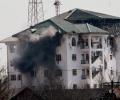
'Just this week, the Indians killed a Kashmiri terrorist, who is a member of Hizbul Mujahideen.' 'This is a nasty terrorist organisation, and did Pakistan welcome this killing?' 'No, in fact, they denounced it and referred to him as a Kashmiri separatist.' 'These Kashmiri terrorist groups have been aided by the Pakistani State.'

Tensions between India and Pakistan are escalating following last week's dastardly terror attack in Pahalgam that claimed 26 lives.
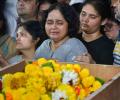
The US has issued a 'Do Not Travel' advisory for Jammu and Kashmir citing potential for terrorist attacks and violent civil unrest. The advisory, issued on Wednesday, comes a day after a deadly terror attack in Pahalgam that killed 26 people, mostly tourists. The advisory also warns against traveling within 10 kilometers of the India-Pakistan border.

Doval said India hit nine terror targets crisscrossing Pakistan with precision and missed none of them
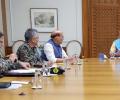
India has called Pakistan's nuclear bluff with Operation Sindoor and sent a psychological message to state-sponsored terrorists: nobody is untouchable and no place in Pakistan is safe for you, government sources said on Sunday.
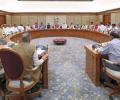
The meeting under the chairmanship of Prime Minister Narendra Modi has been convened at 11 am on Wednesday.
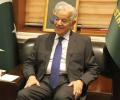
Last week, Information Minister Atta Tarar had said that 24-36 hours were important, fearing a possible strike by India. However, the time passed and there was no action by India.
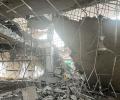
'India won't take anything from Pakistan lying down.'

Sheikh Sajjad Gul, the head of Lashkar-e-Taiba proxy The Resistance Front (TRF), has been identified as the mastermind behind the Pahalgam terror attack that killed 26 people in April. Gul, who is based in Pakistan, has a history of planning terror attacks in Kashmir, including targeted killings, grenade attacks, and ambushes of police personnel. He was designated a terrorist by the NIA in 2022 and a reward of Rs 10 lakh was placed on his head. The TRF claimed responsibility for the Pahalgam attack, where tourists were shot at point-blank range after being asked their religion. Gul's history includes a 2002 arrest in Delhi for planning serial blasts and a subsequent 10-year prison sentence. After his release, he moved to Pakistan and became the leader of the TRF in 2019, a move orchestrated by the ISI to present a facade of an indigenous terror movement in Jammu and Kashmir.
Pakistan's Deputy Prime Minister and Foreign Minister Ishaq Dar has warned India of a strong response, saying Pakistan will respond to a "brick with a stone" if India takes any action against Pakistan, amid heightened tensions following the April 22 terror attack in Jammu and Kashmir's Pahalgam. Dar alleged that India might have staged the Pahalgam attack to abolish the Indus Waters Treaty (IWT) and warned that any attempt by India to interfere with the treaty would be considered an act of war. He also said that Pakistan had no involvement in the Pahalgam incident and is getting support from countries like Saudi Arabia, China, the United Arab Emirates, the United Kingdom, Kuwait, Bahrain, and Hungary.
The appellant argued though he was held guilty of indulging in preparatory acts for the commission of a terrorist act and recruiting persons for terrorist act, there was no evidence to show he committed such acts.
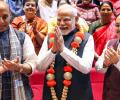
In his first address to National Democratic Alliance MPs in over a year, Prime Minister Narendra Modi on Tuesday emphasised its collective identity as a natural and organic alliance, asserting that its journey since its foundation in 1998 is dotted with successes and has many more achievements in store.

India has suspended the Indus Waters Treaty with Pakistan, citing sustained cross-border terrorism and security concerns. The treaty, brokered by the World Bank in 1960, governs the distribution and use of the Indus river and its tributaries between the two countries. India's decision follows a recent terror attack in Jammu and Kashmir, and has been met with strong condemnation from Pakistan.
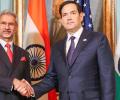
The phone conversation came amid escalating tensions between India and Pakistan over the April 22 terror attack that killed 26 civilians.
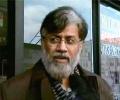
Tahawwur Hussain Rana, an accused in the 2008 Mumbai terror attacks, has been extradited to India from the US. Former home secretaries believe he will be convicted and could face the death penalty. Rana was an associate of David Coleman Headley, who played a key role in the attacks. The extradition is seen as a significant achievement for India and a message to terrorists that they will face justice. Rana's testimony is expected to provide valuable information about the planning and execution of the attacks.
'International cricket is incomplete without Pakistan.'
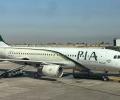
India has closed its airspace to flights operated by Pakistani airlines in a retaliatory move following the Pahalgam terror attack. The ban will be in effect until May 23 and applies to all aircraft registered in Pakistan, as well as planes operated, owned or leased by Pakistani airlines and operators. This comes a week after Pakistan closed its airspace to Indian carriers. The move is part of various measures taken by the Indian government against Pakistan in the wake of the Pahalgam terror attack that killed 26 people.
She has been booked under the relevant sections of the Official Secrets Act and the Bharatiya Nyaya Sanhita, said the police.
As tensions escalated between India and Pakistan following the deadly Pahalgam terror attack, Iran reached out to both countries, urging de-escalation. Saudi Arabia also expressed concern, with its foreign minister engaging in phone conversations with his Indian and Pakistani counterparts. Iran's foreign minister, Seyed Abbas Araghchi, emphasized the importance of bilateral relations, stating Tehran's willingness to "forge greater understanding" at this critical time. Saudi Arabia's foreign minister, Faisal bin Farhan Al Saud, spoke with both India's External Affairs Minister S Jaishankar and Pakistan's Foreign Minister Mohammad Ishaq Dar. Amidst heightened tensions, India has taken a series of punitive measures against Pakistan, including suspending the Indus Waters Treaty and downgrading diplomatic ties. Pakistan responded by shutting its airspace to Indian airliners and suspending all trade. Both countries exchanged warnings, with Pakistan emphasizing its commitment to "respond firmly to any aggression."
"It is shocking to note that Turkey, the second-largest arms supplier to Pakistan after China, has played a key role in modernising Pakistan's navy and enhancing its aerial warfare capabilities. "This defence collaboration is not just commercial; it is ideological, targeting the stability of South Asia and emboldening Pakistan's military adventurism," SJM national co-convenor Ashwini Mahajan said in a statement.
The sources said Misri reiterated the government's stand that the decision to stop military actions was taken at a bilateral level, as some opposition members questioned US President Donald Trump's repeated assertions about his administration's role in stopping the conflict.
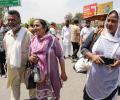
India has revoked all visas issued to Pakistani nationals effective April 27, advised Indian nationals in Pakistan to return home, and suspended visa services to Pakistani nationals. The move comes in retaliation to the Pahalgam terror attack that killed 26 people and alleged cross-border links to the attack. This escalation follows India's previous actions against Pakistan, including expelling Pakistani military attaches, suspending the Indus Water Treaty, and shutting down the Attari land-transit post.
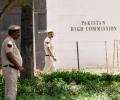
Pakistan is holding a high-level security meeting to formulate a response to India's suspension of the Indus Water Treaty and downgrading of diplomatic ties. The meeting, convened by Prime Minister Shehbaz Sharif, will include the National Security Committee, three services chiefs, and key ministers. The move comes after India blamed Pakistan for a terror attack in Pahalgam, which Pakistan has denied. Diplomatic observers warn that the escalation could further strain relations between the two countries.

India will oppose the World Bank funding to Pakistan next month, arguing that Islamabad has used such funds in the past to procure arms and ammunitions. India previously lobbied against the IMF extending a USD 2.3 billion assistance to Pakistan earlier this month, presenting evidence of Pakistan's misuse of funds for military purposes. India feels that Pakistan has failed to act on terror emanating from its territory and has been diverting funds from multilateral agencies to buy arms and ammunition.

Strategic affairs experts express concern over US President Donald Trump's tariffs on India, his 'bullying tactics,' and increasing attempts to hyphenate New Delhi with Islamabad, signaling a potential shift in the bilateral relationship.
